
Case Study
Bonsai Accelerates Off-Road Autonomy on Anyscale
Bonsai Robotics empowers the perception team to move fast with scalable cloud compute for multimodal data preparation and large-scale training. By abstracting infrastructure operations for foundation model development, Anyscale frees developers to focus on today’s research while supporting long-term growth initiatives.
4X
Experimentation speed up with managed platform
10X
Larger datasets used for foundation model training
Multi-cloud
Portable AI workloads that run on AWS and GCP
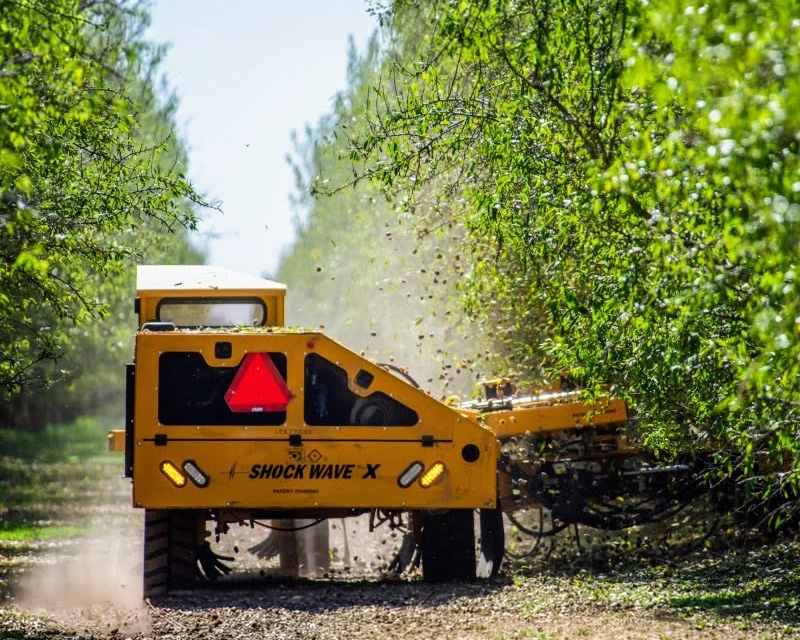
Bonsai Robotics is building the next generation of off-road autonomy, starting with a focus on agriculture. Traditional off-road autonomy relies on either relatively small models trained on small datasets, manually engineered heuristic algorithms, or even plain GPS. These autonomy systems are generally unreliable in challenging conditions such extreme dust, and cannot generalize between tasks as they have been hand-crafted to do a single task well. Bonsai instead takes a modern approach of collecting a large and diverse dataset over many different vehicle classes and tasks, and uses that data to train its own models which can generalize across tasks.
To accelerate their innovation speed, the team needed a multi-cloud compute platform that could scale experimentation beyond the limits of their on-prem environment without the operational burden of cluster management. They chose Anyscale to support large-scale model training and multimodal data processing across millions of data points today, while laying the groundwork for more automated continuous learning and reinforcement learning workflows in the future.
LinkChallenges
To continuously build autonomy that can adapt across diverse crops, environments, and machine types, Bonsai Robotics is steadily growing multimodal datasets collected and labeled from real-world deployments. This has made perception one of the most data- and compute-intensive parts of their AI workflow.
As they scaled their autonomy efforts, Bonsai faced three challenges:
Limited compute capacity constrained experimentation velocity: Fixed on-prem GPU resources forced researchers to run experiments sequentially, slowing iteration despite a growing backlog of ideas. As datasets and model sizes increased, compute limits became a direct bottleneck to innovation.
Infrastructure fragility as data and workloads scaled: Each increase in dataset size or pipeline complexity risked breaking infrastructure. In the past, this had led to failed runs that translated into hours or days lost to debugging. Engineers were frequently pulled away from research to fix systems instead of running experiments.
End-to-end experimentation complexity across data, training, and deployment: Bonsai’s workflows span large-scale data preparation, foundation model training, evaluation, and field deployment for continued learning. While unblocking training was the first critical step, developer velocity ultimately depended on scaling data processing and inference as part of a single experimentation loop.

John Macdonald | Head of Perception, Bonsai Robotics
LinkThe Solution
With Anyscale, Bonsai Robotics gained a managed, multi-cloud compute platform powered by Ray that scales perception workloads across data processing and training without the operational burden of managing clusters or Kubernetes in the cloud.
With Anyscale, Bonsai is able to:
Scale experimentation on any cloud: Anyscale’s multi-cloud flexibility allows Bonsai to run workloads across AWS and GCP, removing compute constraints as datasets and model sizes grow. This enables the team to unlock additional GPU capacity over time and take advantage of different hardware availability and cost profiles across clouds.
Reliable experiments with 10x larger datasets: By abstracting away infrastructure and cluster operations, Anyscale allows the team to scale datasets by an order of magnitude or more without rewriting orchestration code as data volumes increase. Engineers can focus on building data processing and training logic rather than maintaining ad hoc parallelization code or fixing infrastructure
Accelerate end-to-end experimentation by 4x: Built on Ray’s unified compute engine, Anyscale enables Bonsai to scale foundation model training and extend the same platform to large-scale data processing. The perception team can run many experiments in parallel, onboard new researchers faster, and use built-in observability to debug and optimize workloads, reducing end-to-end experiment cycles from days to hours.

Ugur Oezdemir | Co-Founder and CTO, Bonsai Robotics
LinkFrom on-prem constraints to cloud-powered scale
As Bonsai Robotics scaled perception workloads for autonomous systems, the limits of fixed on-prem infrastructure became increasingly clear. While on-prem GPUs can appear cheaper on paper, fixed capacity meant researchers were often waiting in line for compute and running experiments sequentially, ultimately impacting model quality. These constraints slowed iteration, reduced experimentation volume, and introduced hidden costs in the form of delayed insights and lost developer productivity.
Anyscale provides multi-cloud support across AWS and GCP from day one, with the flexibility to extend to other clouds as needed. This allows Bonsai to access GPU capacity when availability is constrained in one cloud, or optimize workloads based on instance cost and hardware availability, driving both operational efficiency and ongoing cost-saving opportunities as their needs evolve.
John Macdonald | Head of Perception, Bonsai Robotics
LinkScaling data without slowing experimentation
As Bonsai Robotics expands autonomy across crops, seasons, and machine types, the company has made sustained investments in collecting and labeling real-world data from diverse operating conditions. Perception systems that must function reliably in environments like dusty orchards, variable terrain, and across specialized agricultural equipment demand exposure to a wide range of edge cases. As a result, Bonsai’s datasets quickly grew into the tens of millions of frames that needed to be processed and trained on.
By enabling large-scale parallel execution on managed, reliable clusters, Bonsai can now process and train on datasets an order of magnitude larger without waiting an order of magnitude longer. The combination of Ray’s parallel compute model and Anyscale’s managed platform and expert Ray support allows the team to maintain experimentation velocity as data continues to grow. Bonsai can support more concurrent experiments and more developers working in parallel to continue advancing on their mission to deliver more cost-efficient farming with autonomous systems.
John Macdonald | Head of Perception, Bonsai Robotics
LinkScalable foundation model training
As Bonsai Robotics scaled its autonomy platform, the perception team made a deliberate decision to unblock model training first. Training of foundation models is the most compute-intensive and time-critical bottleneck. Impact on training directly limits how quickly new ideas could be tested and validated.
For Bonsai developers, Anyscale Workspaces make it easy to get started quickly, providing a local development experience through an integrated IDE backed by cloud-scale compute. Built-in observability helps the team quickly identify performance bottlenecks and debug failed runs. With Anyscale Jobs, different experiments can run in parallel on production-grade, ephemeral clusters – making it easy to turn any research idea into a production-scale experiment without manual provisioning or operational overhead.
John Macdonald | Head of Perception, Bonsai Robotics
LinkWhat’s Next for Bonsai Robotics
Bonsai Robotics plans to continue accelerating developer velocity by extending its use of Ray on Anyscale beyond training to large-scale data preprocessing. By scaling data preparation alongside model development, the team aims to shorten iteration cycles and make it easier for researchers to experiment with larger, more diverse datasets without introducing new infrastructure bottlenecks.
Looking ahead, Bonsai is focused on building tighter, more automated learning loops between models deployed in the field and the data used to improve them. By streamlining how models are deployed, how data is collected and labeled, and how those datasets are fed back into training, the team plans to continuously refine its foundation models and develop more task-specific models that can operate together as part of agentic autonomy systems, pushing agricultural automation further and faster.
“In autonomous system development, early data and AI infrastructure decisions have an outsized impact on experimentation speed. For Bonsai, Ray on Anyscale is the scalable foundation that keeps our team focused on advancing our differentiated models, not managing infrastructure.”
Ugur Oezdemir
Co-Founder and CTO, Bonsai Robotics