Learning Loops: The Path to Owning Your Intelligence
AI is rewriting the value equation for companies. We are emerging from the era of token-maxxing into the future of differentiated intelligence.
Companies are shifting strategy toward building intelligence as a durable moat for their business. As a result, we’re seeing the same three words plastered across every billboard, bus, and train in tech hubs globally: Own Your Intelligence. But what does that actually mean? What does it take to get there?
In this blog, we present what we see as the answer to the question of owning your intelligence: learning loops. We will cover what is a learning loop, the maturity curve we believe most companies will go through to build them, the engineering investment required to make this a reality, and where Ray and Anyscale fit into this picture.
LinkWhat is a learning loop?
A learning loop is the compounding flywheel of connecting data curation, custom model training, and inference, all powered by your proprietary data. This concept isn’t new. However, in the age of LLMs and agentic systems, the scale, complexity, and infrastructure investment to build a learning loop is exponentially higher, and the cost to your business of waiting grows every month.
Companies face three challenges to build a learning loop:
Curating large-scale (TB-PB) proprietary datasets, many of which are multimodal
Training custom models faces compute scarcity, sprawl, and reliability challenges as jobs span multiple GPU nodes for weeks at a time
Scaling inference to meet latency requirements requires elasticity and performance tuning spanning multiple layers of the stack

Once deployed, learning loops create a compounding effect: the end user interface collects data, that data is processed and curated, used for training an improved custom model or agent, tested using evals, and deployed out for inference. Every rotation of this loop creates more performant, efficient, or cost effective differentiation for a business.
LinkThe Maturity Curve
Because of the high upfront complexity and cost to deploy increasingly differentiated learning loops, we see a maturity curve emerging.
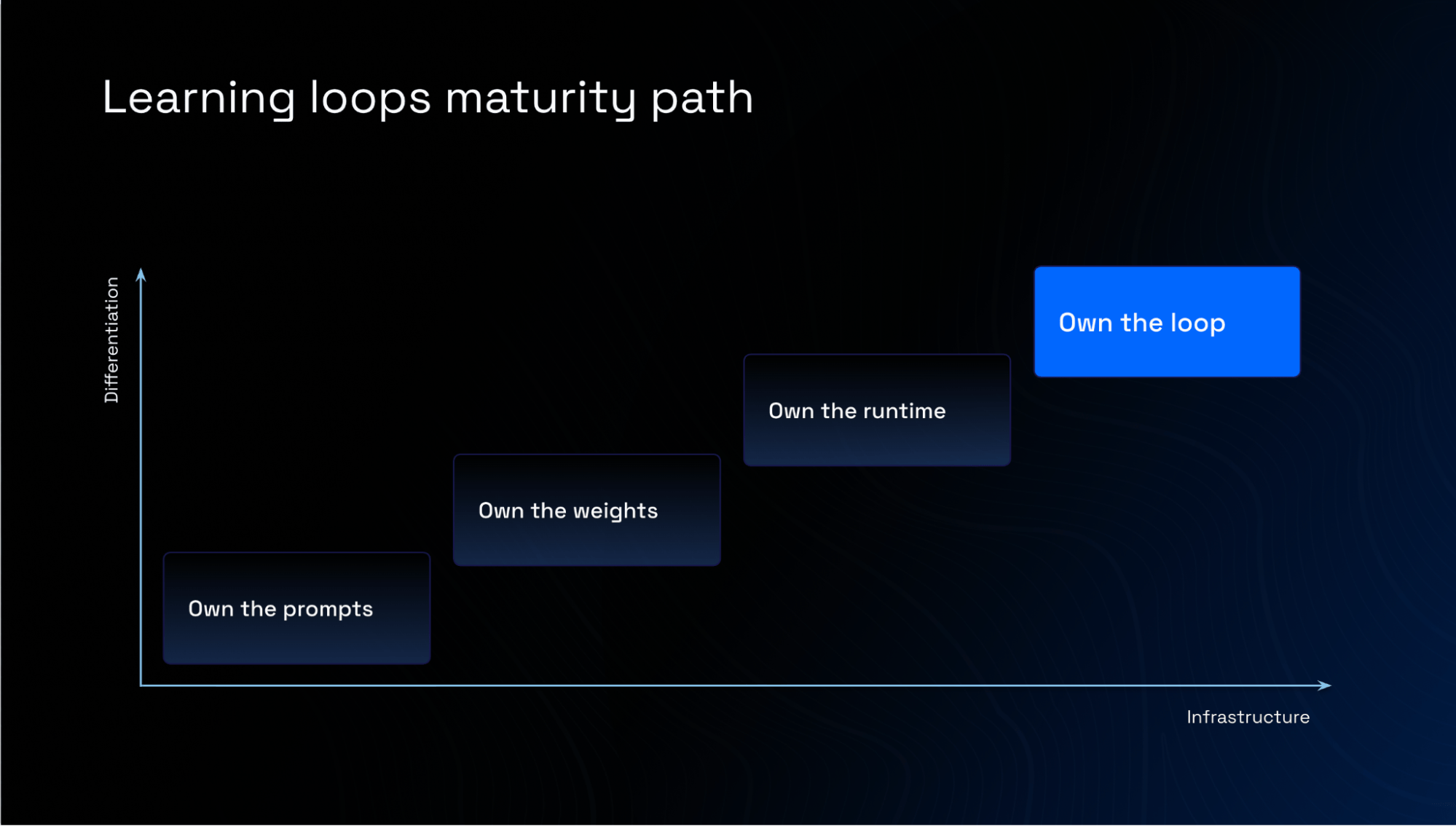
Step 1: Own the prompts: Rent a model and invest time into your own prompts and evals. Prove ROI before investing more into the underlying infrastructure.
Expect costs to grow linearly or higher with usage because every token is a line item in a long chain of rented intelligence, runtime, and infrastructure. When you’re using a model and intelligence that anyone else can access, your differentiation also rests on a thinner layer of prompts and workflows.
Step 2: Own the weights and runtime: When cost, performance, and reliability become a key for differentiation, it’s time to invest in the infrastructure to stop calling proprietary models and start using your data to differentiate at the model weight layer.
This layer starts to require data curation and training pipelines. You don't want those priced per token. Curation and training are steady, heavy workloads, and paying for them by the token means paying a premium for work you could be scheduling yourself. This is where the runtime investment begins. Now you control how workloads execute, which optimizes for cost, performance, and reliability against your infrastructure investment.
In addition to cost and performance, security and data sovereignty become another layer of differentiation at this step. These systems move, transform, and activate proprietary data with the ultimate goal of turning that data into a token. When teams are investing tens or hundreds of millions of capex into GPU infrastructure, you need control over that data and the tokens it yields.
Step 3: Own the Loop: Once you have the foundations of data, training, and inference deployed, you can start the path of owning and optimizing the loop toward deeper intelligence moats.
You want every cycle faster and every run to be more cost effective. The organization’s cost mental model will also begin to change from cost per token to cost per unit of work (such as cost per image processed).
You’ll optimize for more work from the same resources, and more differentiation out of every rotation of the loop.
LinkThe Architecture
With every move between these stages, you are building differentiation, but you are also taking ownership of more layers of the stack. In doing so, the importance of how each of those layers work together becomes critical in order to deliver intelligence cost-efficiently at scale.
Every one of these loops is really several workloads. Data processing, training, simulation, inference, each with a different hardware and orchestration requirements. The challenges of these workloads collide with the platform challenges of scaling this out across many users, running many workloads, across many clouds and accelerators.
What we see emerging is a new architecture that allows teams to scale from one workload to many workloads, with the capabilities to manage a sprawling compute fleet.
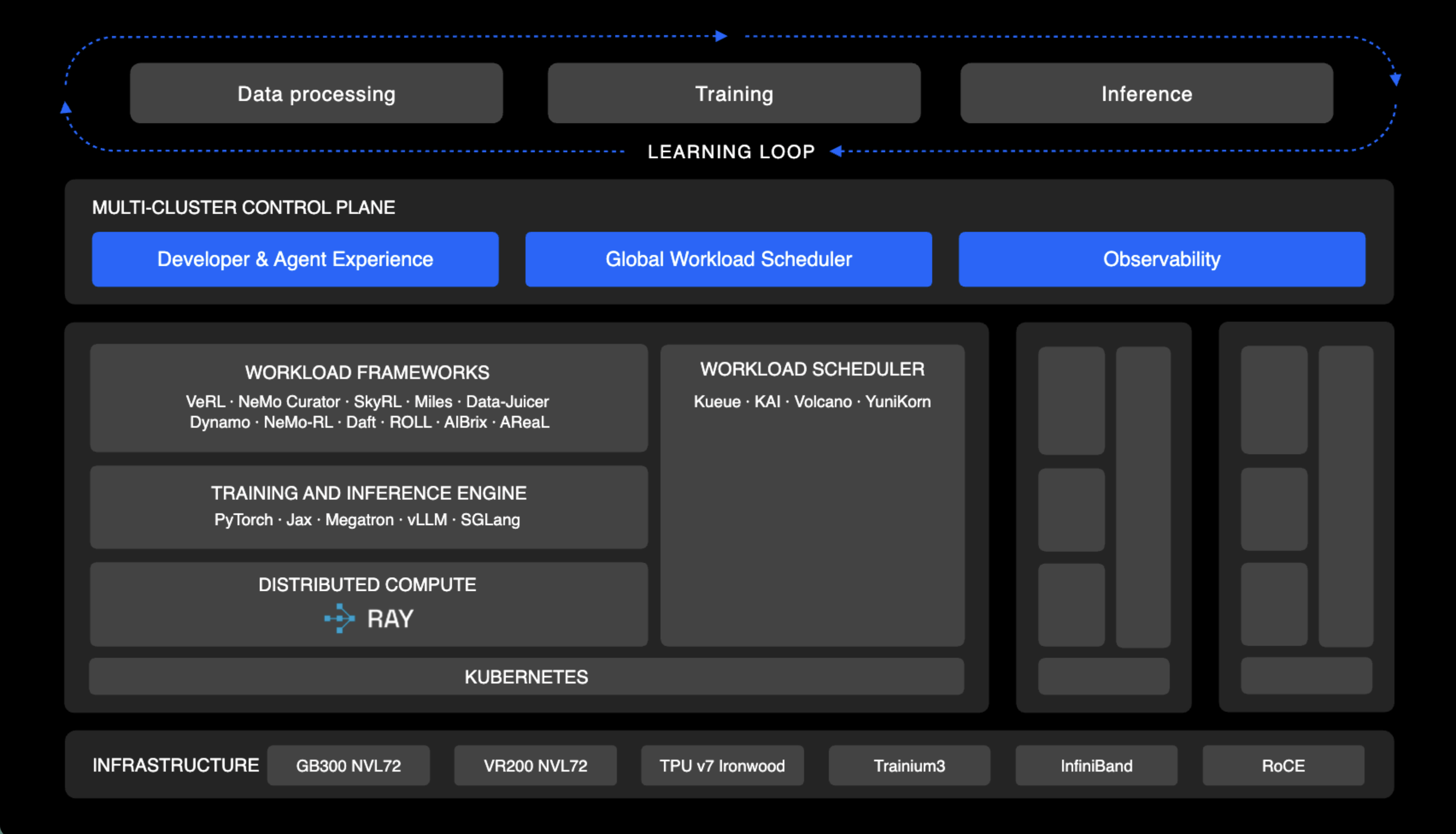
This architecture leverages Ray as the distributed computing foundation for scalable and fault tolerant workload scheduling, workload orchestrators like Kueue, Kai, Volcano and Yunikorn for prioritization of competing jobs.
This stack is topped by a global control plane, fusing information and access from every layer, from the infrastructure to the control plane, and everything in between, to create a unified stack. The control plane is about giving the right interfaces, the right access, and the right observability to developers AND agents. This includes job management, placement, prioritization, and preemption at the global level, which of course must be done in close coordination with the individual cluster and workload level.
When a user’s workload requests a hundred GPUs, Ray and Kubernetes coordinate placement, often needing to be topology-aware, while Ray and tools like Kueue evaluate the capacity, priority, and impact to other running jobs. The handoffs between each of these boxes are where jobs succeed or fail, GPU utilization improves or stagnates, and whether your team is getting paged or enjoying a good night of sleep.
What you end up with is a stack giving you a golden path - make it easy to do the right things, by default, on every cloud and substrate - as you build learning loops.
These challenges and this stack are exactly what we have been building toward at Anyscale and Ray.
Find more details here.