Ray Summit 2026: Physical AI, RL, and the infrastructure that runs them all
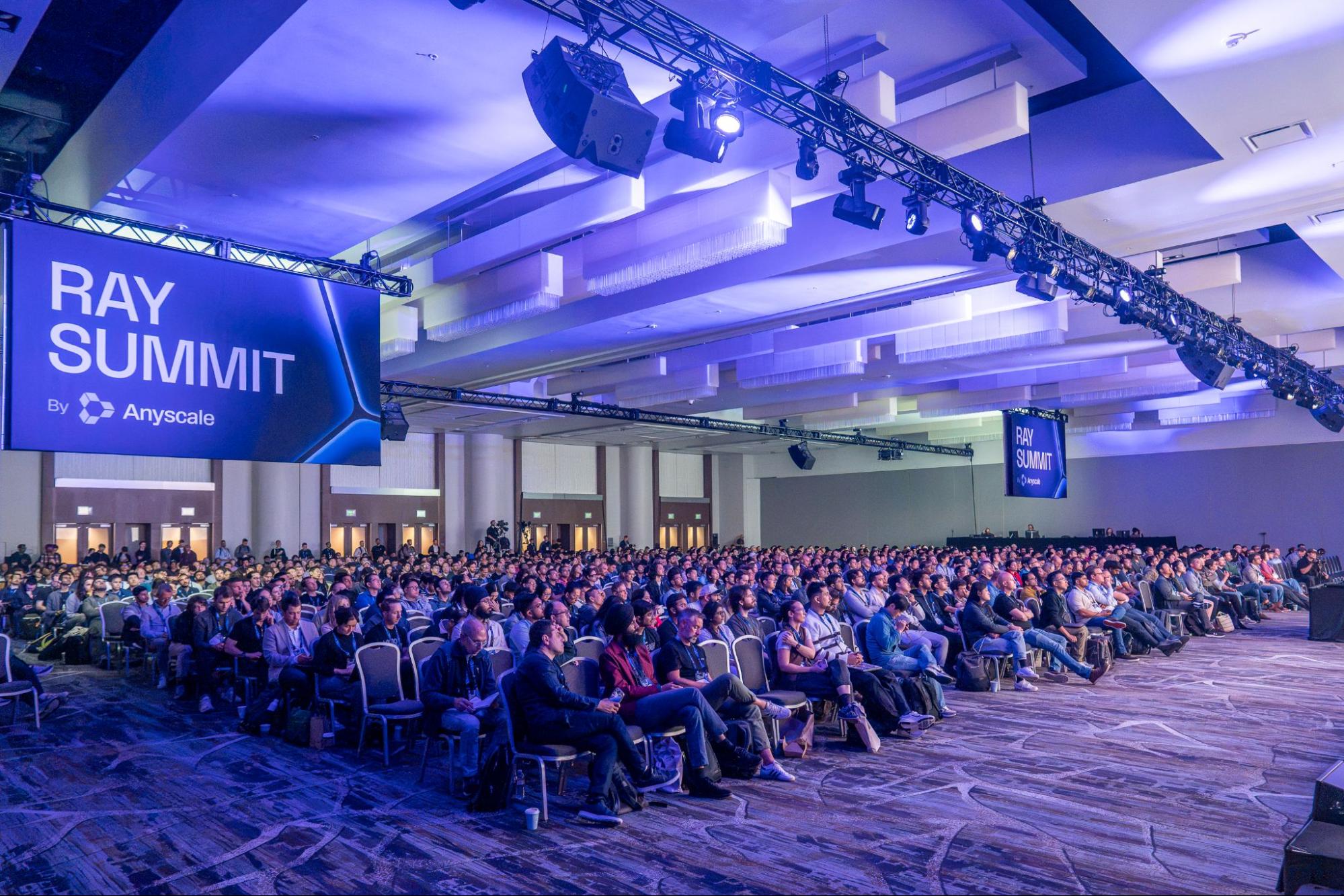
Ray Summit 2026 on August 24-26 brought together more than 2,000 attendees at the San Francisco Marriott Marquis for two days of keynotes, breakout sessions, and hands-on training built around a single through-line: reinforcement learning has graduated from a research topic into a production engineering problem, and the infrastructure that holds RL pipelines together is now as consequential as the models it trains.
Robert Nishihara, co-creator of Ray and co-founder of Anyscale, opened Day 1 by anchoring the conference in that premise. The workloads driving frontier AI today involve continuous RL training loops, agentic rollouts, and physical simulation at scale, all of which require compute environments that span heterogeneous hardware, coordinate between CPU workers and GPU pools, and recover from failures without forcing researchers to rebuild the orchestration layer from scratch.
LinkDay 1 keynote
LinkBuilding a scaled verifier for science at Lila Sciences
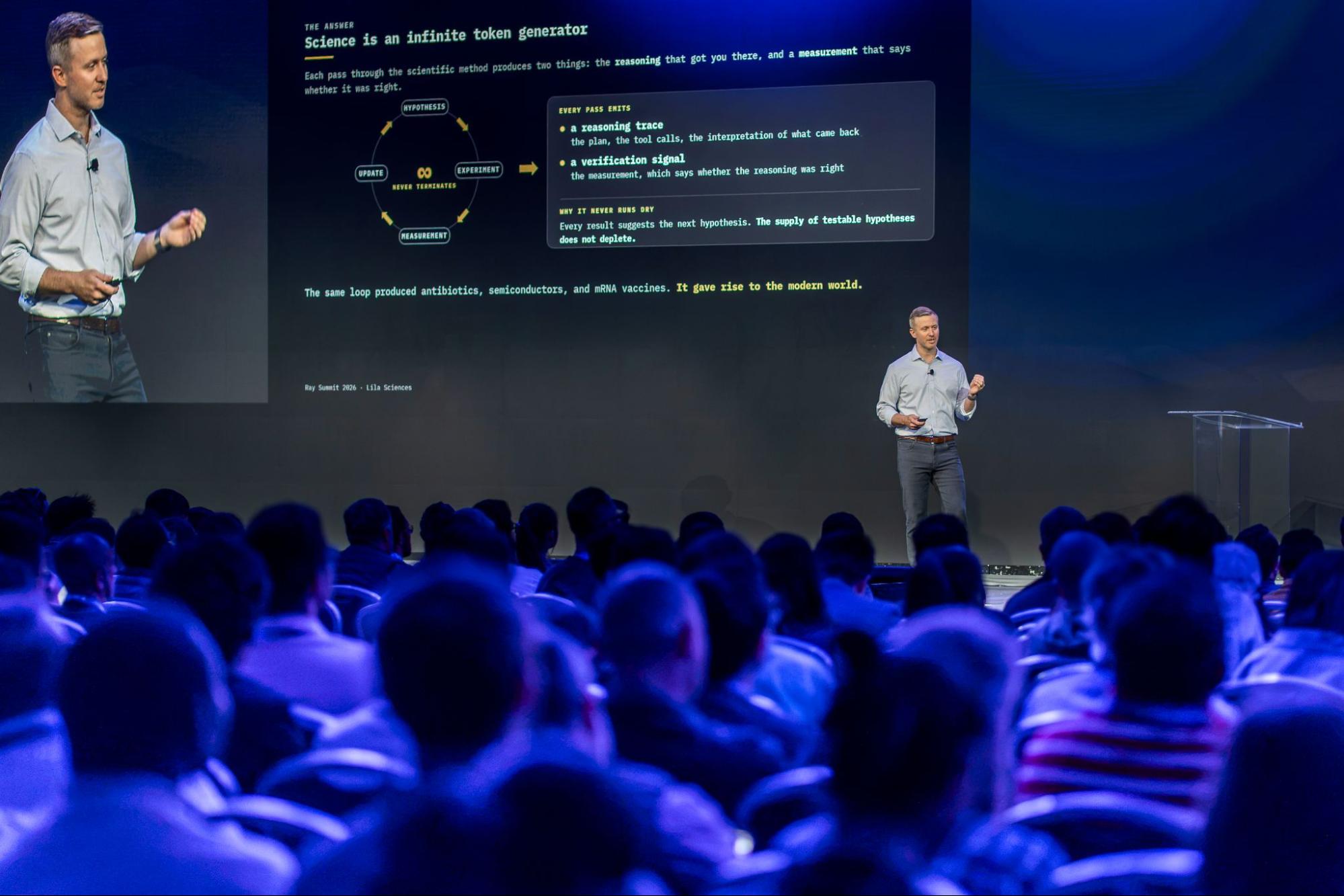 Presented by Andrew Beam, CTO, Lila Sciences
Andrew Beam opened around the verifier problem at the heart of scientific RL. RLVR has worked in coding and math because those domains have cheap, automatic verifiers, but only about 5% of bio, chem, and materials literature contains claims that can be settled fully in silico. The answer Lila has built is an AI Science Factory: a 15,000-square-foot facility in Cambridge combining AI models, software that wraps every instrument behind a single API, and robotics running experiments around the clock, so the physical workcell becomes the reward signal. Their model IRIS trains across proteins, RNA, small molecules, catalysts, and coatings, with RL developed jointly with the SkyRL team on Ray. Results to date include a CAR-T program reaching non-human primate efficacy data at roughly 30 times lower cost than conventional timelines, more than one million mRNAs designed and tested in vivo against leading clinical benchmarks, and 719 protective coating alloys screened in five weeks rather than seven months.
LinkBuilding AV 3.0 at Torc Robotics
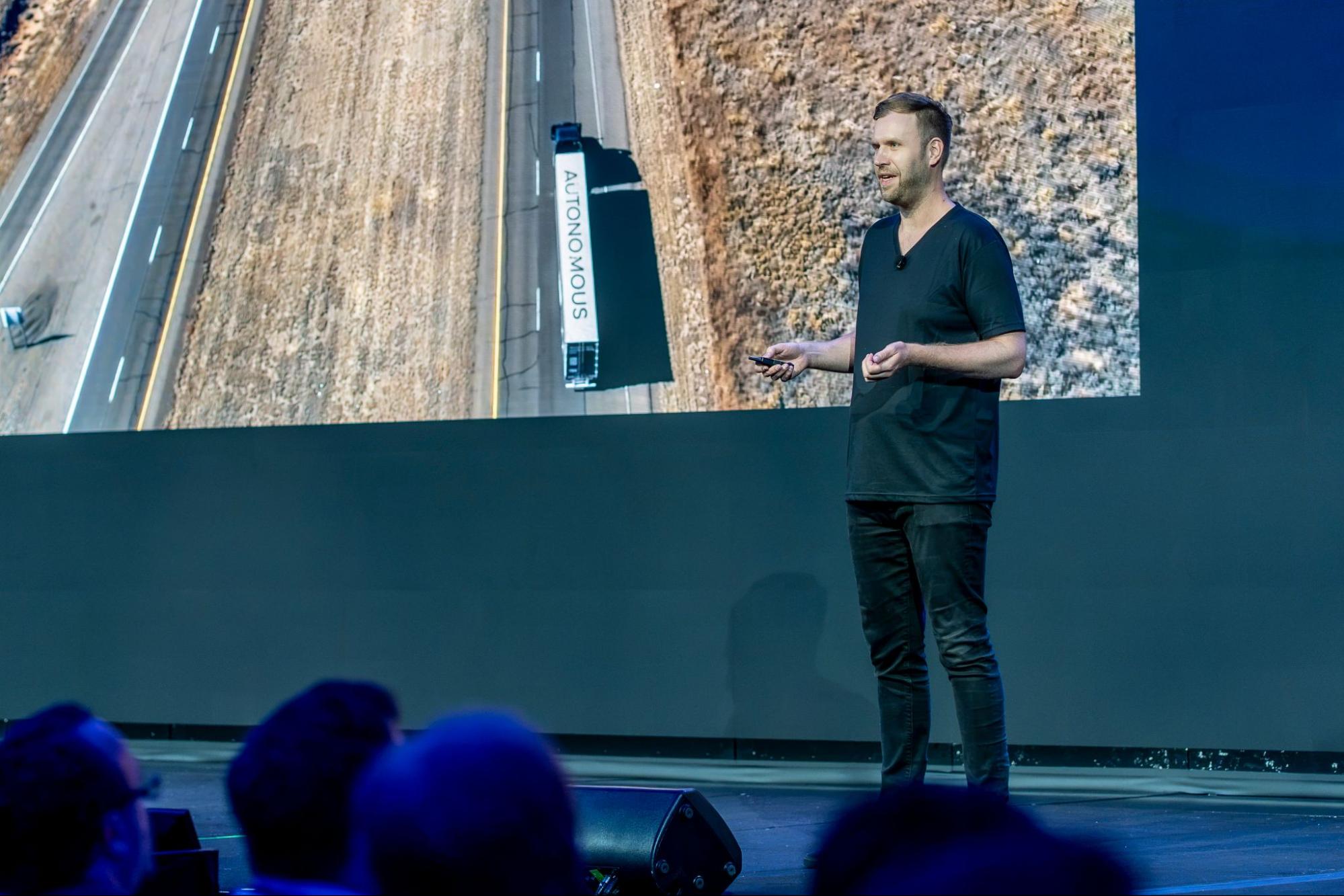 Presented by Felix Heide, Head of AI, Torc Robotics
Felix Heide presented AV 3.0, Torc's approach to safe autonomous trucking in which perception and planning are learned end to end and closed-loop RL in simulation drives policy improvement. Urban driving benchmarks are saturating and the hard problems have moved: trucking requires ultra-long range detection, high ego speeds, and trajectory lengths that existing datasets were not built to cover. TruckDrive, a dataset Torc developed, fills that gap. Their planning model Alpamayo reaches a min-of-6 Average Displacement Error of 5.84 meters at the 6.4-second horizon zero-shot, dropping to 0.87 meters with a physical AI reasoning trace. Every stage of the pipeline runs on one Ray cluster with Ray Data, Ray Train, Ray Serve, and Ray Actors coordinating across CPU nodes, Kepler GPUs, and Blackwell GPUs on Anyscale. The result of consolidating five separate training systems onto that one engine: 20 times more data per training job, 3 to 3.4 times faster epochs on cheaper compute, GPU utilization up from 30 to 40 percent to approximately 90 percent, and one billion simulation miles running per week.
LinkInferact and the vLLM community
 Presented by Simon Mo, Co-founder & CEO, Inferact, vLLM
The inference problem has grown into a combinatorial one. The vLLM community is now navigating more than 1,000 hardware configurations, more than 5,000 models, and an expanding set of workload patterns that have shifted from single-turn completions toward multi-turn agentic interactions. The Inferact team and vLLM maintainers outlined where the project is investing: day-zero hardware support for NVIDIA Blackwell and Vera Rubin, AMD MI355X and MI455X, and Google Ironwood and future TPU generations. The technical roadmap includes Model Runner V2 with a flat model interface, llm-d and Dynamo for disaggregated serving, and a Rust-based frontend for reduced overhead at the ingress layer. With more than 3,000 contributors, vLLM has grown into one of the central open inference substrates in the ecosystem, and the vLLM-dedicated track in Room Nob Hill ran through both full days of breakouts.
LinkDay 2 keynote
LinkBuilding and post-training open models with Ray: lessons from NVIDIA Nemotron
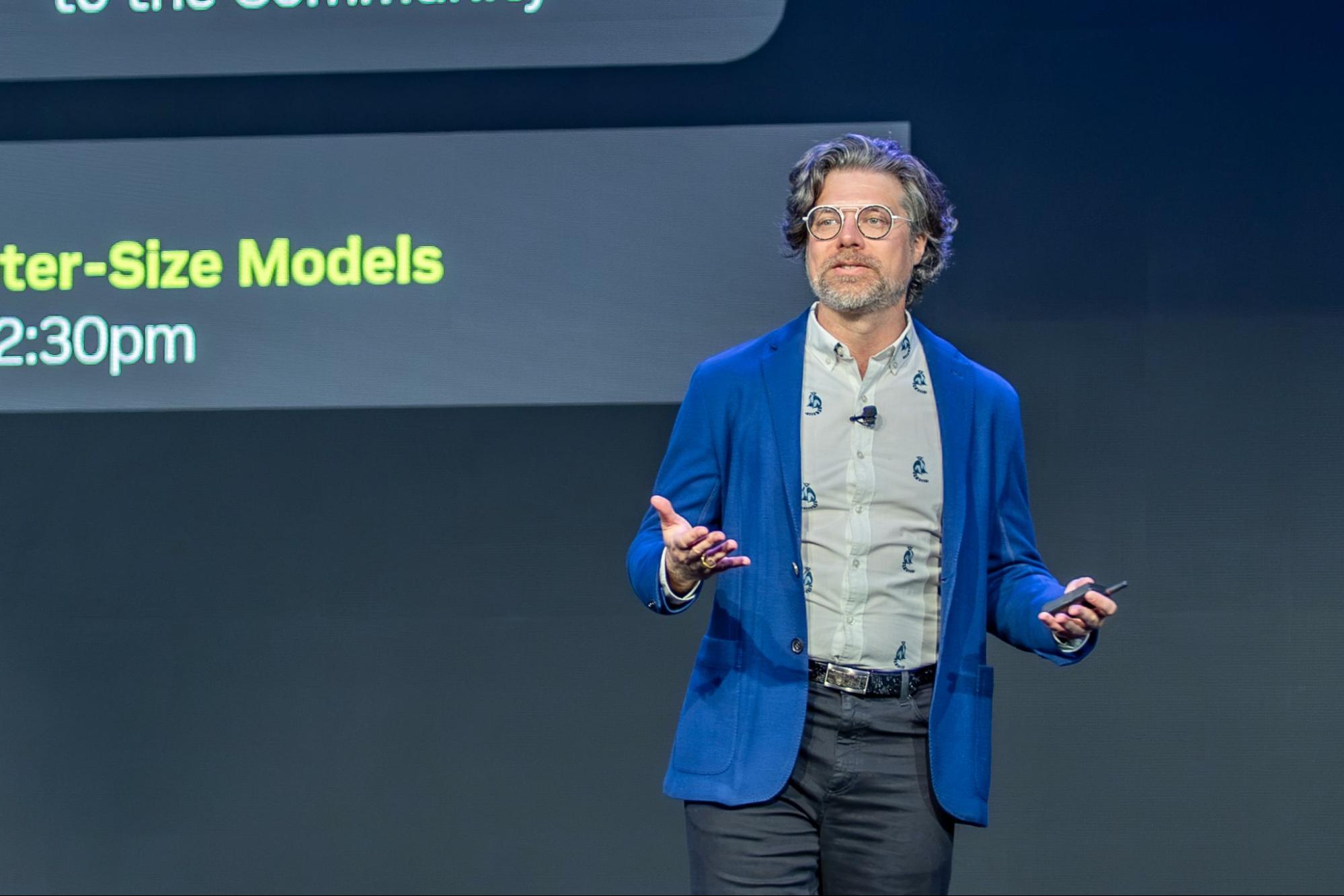 Presented by Bryan Catanzaro, VP of Applied Deep Learning Research, NVIDIA
Bryan Catanzaro reframed what it means to build an open model. Nemotron is a full suite: model checkpoints from Lightning to Ultra, datasets spanning 9 trillion tokens published on Hugging Face, and open libraries for RL alignment (NeMo-RL), model compression (Minitron), and architecture search, designed so any organization can build AI specialized on its own data. The technical core was RL at scale: training Nemotron 3 Ultra (550 billion total parameters, 55 billion active, over 20 trillion pretraining tokens) required coordinating rollout engines, environment workers, and policy training across more than 3,000 GPUs simultaneously on Ray Core. A concrete finding: topology-aware placement on GB300 hardware that kept communicating actors within the same NVLink domain improved RL iteration throughput by 13 percent with no changes to hardware or model. Downstream, CrowdStrike reported security investigations completing up to five times faster, Synopsys up to 50 times faster time to validated RTL, and CodeRabbit improved routing accuracy while cutting estimated serving cost in half.
LinkAdvanced autonomy for the built world at Bedrock Robotics
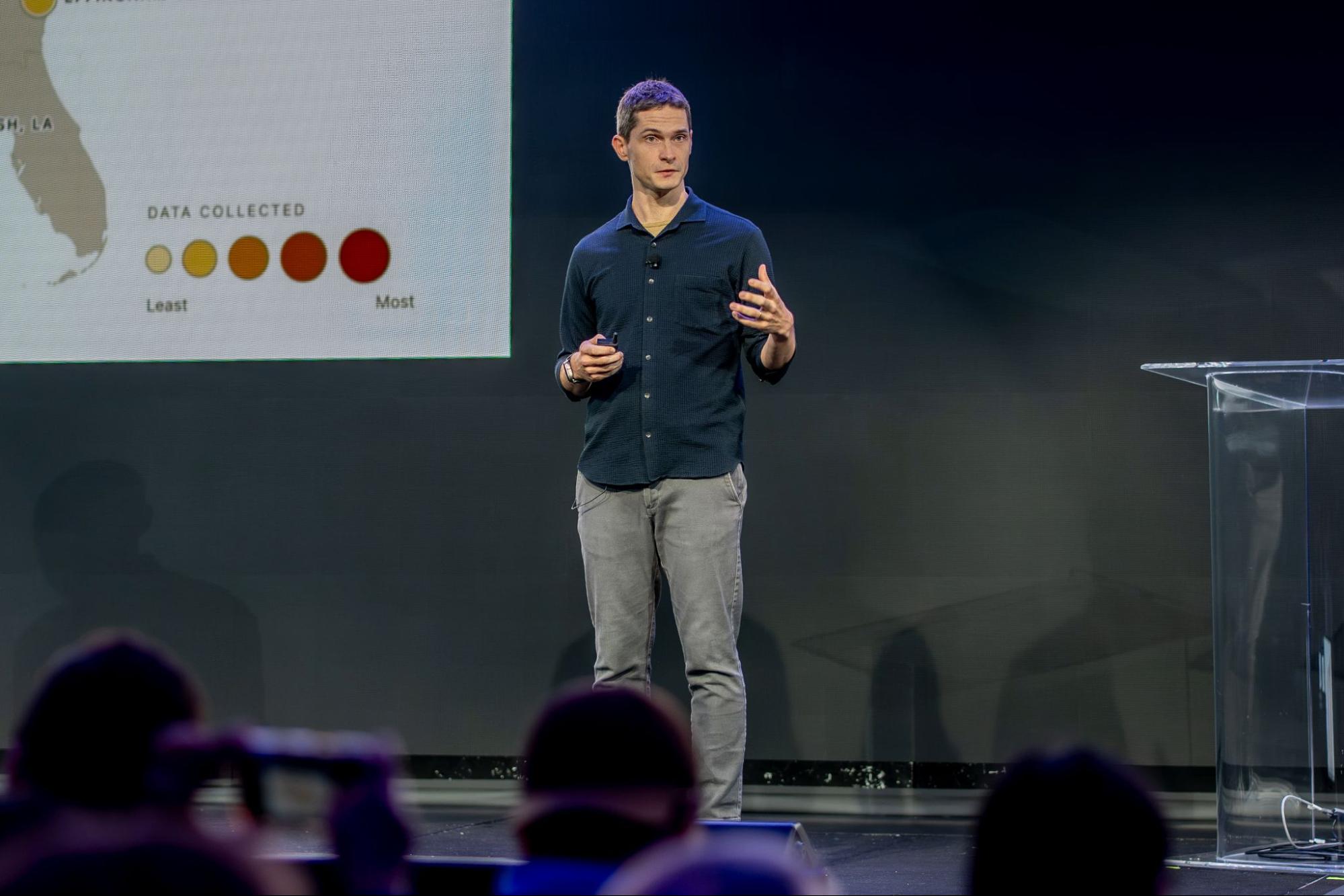 Presented by Vincent Gonguet, Head of Technical Foundations, Bedrock Robotics
Bedrock is building autonomy for job-site equipment, an environment where cameras, lidar, GNSS, IMU, and CAN telemetry generate continuous sensor streams but where the label for any given moment is not defined in advance. Their core insight is that job-site data is fundamentally unlike task-defined robotics data: in a pick-and-place system the task is established before data collection begins, but on a construction site, figuring out what happened (which operator action, which terrain interaction, which failure mode) is itself the output of a distributed compute graph, and Ray runs that graph. Every stage of the pipeline, from sensor decode through agentic labeling through perception and policy training through simulation sweeps, mixes CPU and GPU loads differently, and their full-stack simulator runs the real autonomy stack nightly, generating terrain, physics, sensor feeds, and metrics at scale, so every model change is tested in simulation before it reaches a machine in the field.
LinkClosing the loop: building an AI Scientist at Periodic Labs
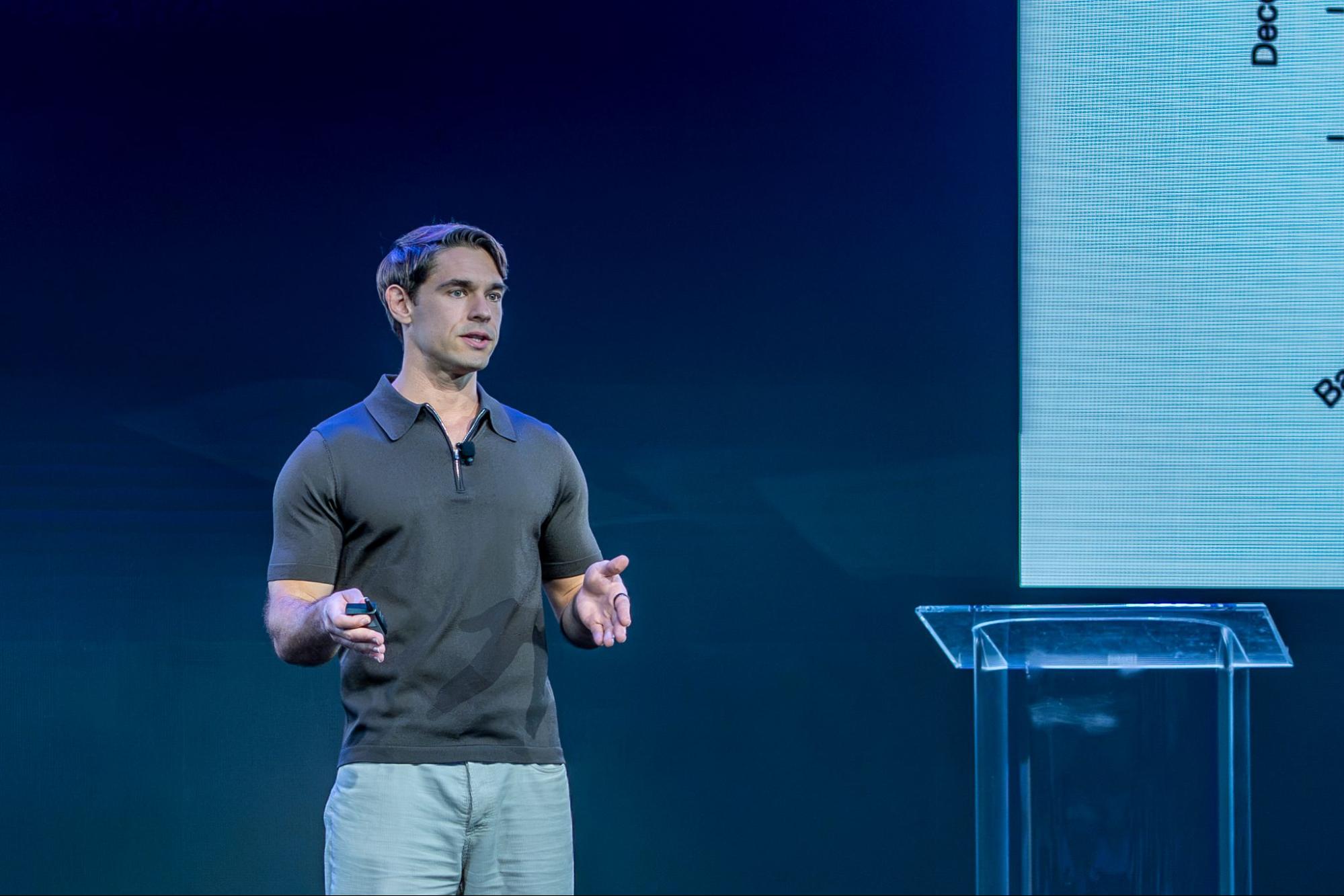 Presented by Liam Fedus, Co-founder & Co-CEO, Periodic Labs
Periodic Labs drew a distinction between AI that knows science and AI that knows how to do science, and built their infrastructure around the difference. Their model trains on the scientific process itself (hypotheses, experimental plans, tool invocations, measurements, and the updates those measurements produce) rather than on the finished record of published results. Running RL in the physical world is harder than in the digital world: rollouts take days rather than minutes, fewer agents run in parallel, and reward signals are noisier. Periodic's response is a stack built on Ray for orchestration, Megatron for training, and SGLang for inference, with proprietary layers for the RL loop, GPU-colocated sandboxes, and serving. Their benchmarks against open-source baselines: 3 times the inference throughput, 10 times faster weight sync, 30 times faster weight conversion, 4.5 times faster training overall, and a job-local P2P data plane running 50 times faster than comparable SOTA providers.
LinkBreakout sessions
LinkScaling LLM workloads on TPUs with Ray: from pretraining to inference with Google Kubernetes Engine
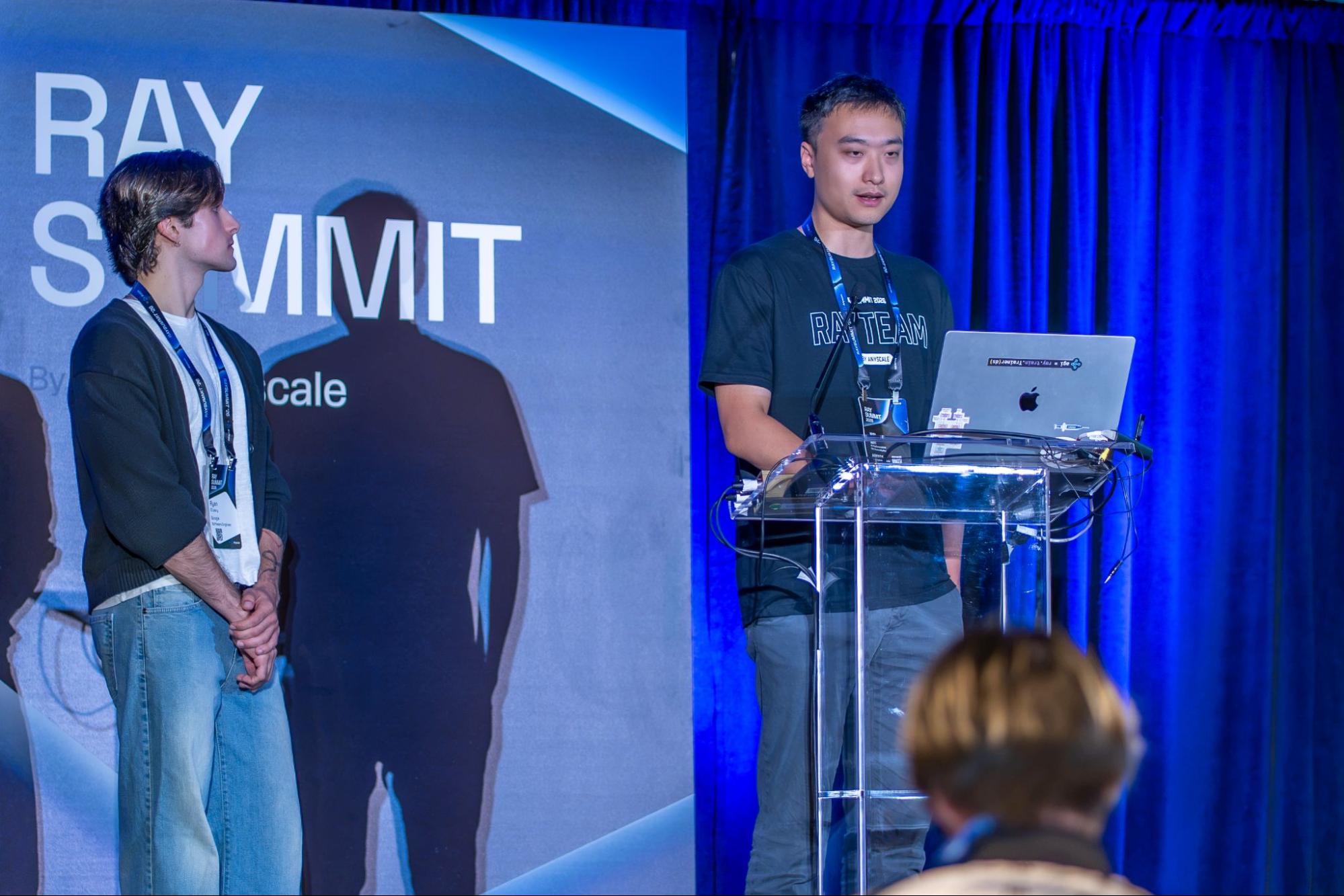 Presented by Ryan O'Leary, Software Engineer, Google Kubernetes Engine; Lehui Liu, Software Engineer, Anyscale, Ray Train
Ryan and Lehui presented the current state of TPU support as a first-class accelerator in Ray on GKE. Two new APIs make TPU topology management tractable at scale: SlicePlacementGroup for reserving and orchestrating entire dedicated TPU slices, and SubslicePlacementGroup for dividing large physical topologies dynamically into smaller subsets without physical cluster reconfiguration. Ray Train supports both JAX and PyTorch across multi-slice configurations with elastic recovery from worker failures and preemption signal handling built in. On the serving side, Ray Serve with vllm-tpu now supports both single-host and multi-host TPU inference with autoscaling, and TPU profiling integrates directly into the Ray dashboard, surfacing compilation deadlocks, device latency, and memory fragmentation without requiring external tooling.
LinkLightning on agentic with vLLM, Verda, Novita and Anyscale
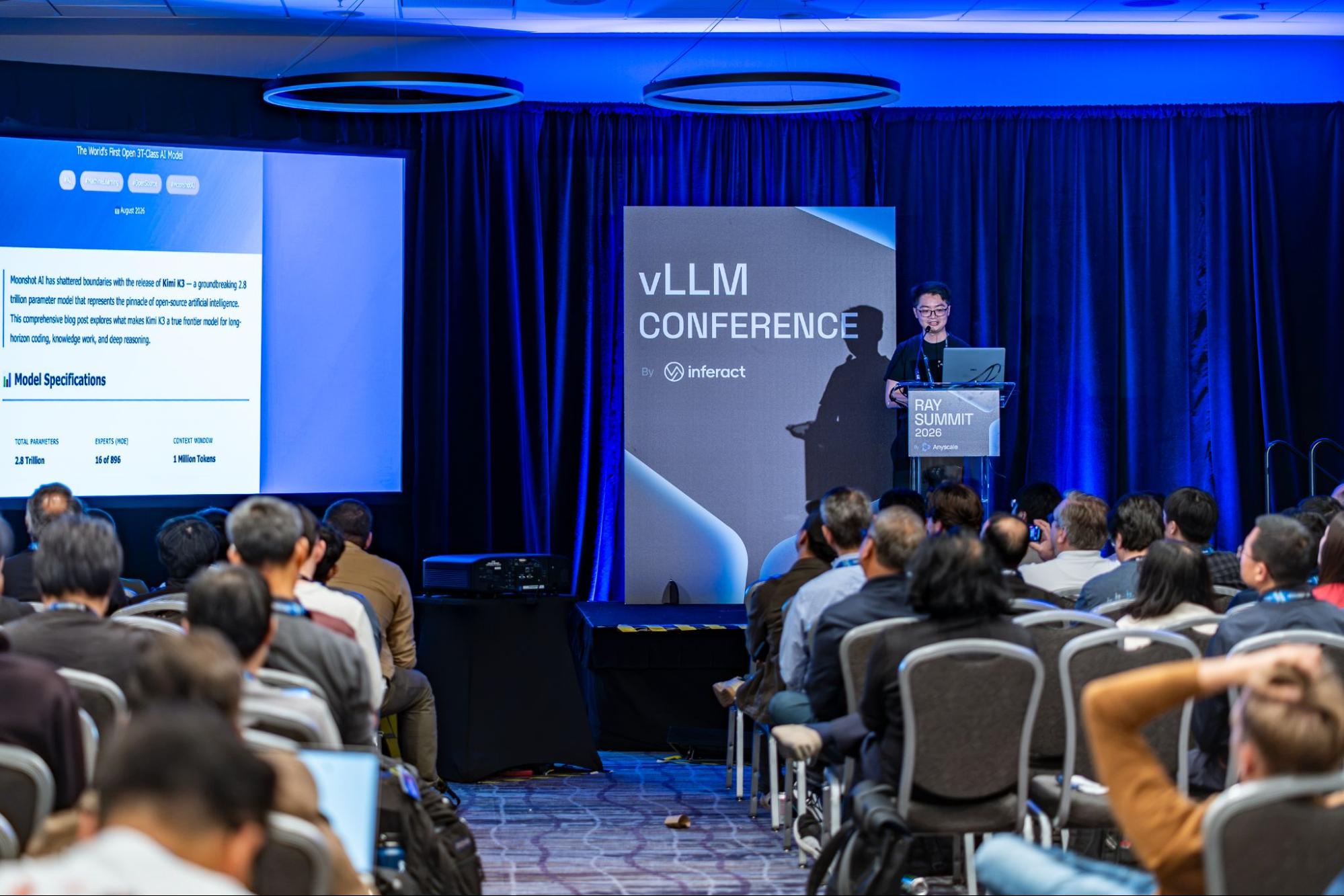 Presented by Tan Tun Jian, Principal Software Engineer, Embedded LLM, and vLLM maintainer; Jeffrey Wang, Software Engineer, Anyscale; Ananth Mahadevan, MLOps Engineer, Verda; Danny An, Senior Kernel Development Engineer, Novita
Tan Tun Jian and team presented Agentic API, a Rust-powered serving layer that fills a specific gap: vLLM executes model inference, but an agent turn also requires restoring conversation history, running tool loops across multiple model calls, and persisting state so the next request can continue where the last one stopped. Without another layer, every agent client builds this infrastructure independently. Agentic API provides it as a shared service, with support for both the OpenAI Responses API and the Anthropic Messages API, meaning Codex and Claude Code can point at open models served by vLLM without each client managing its own state layer. MCP and web search run inside the gateway; function calls are returned to the client for execution and continued with a continuation ID. Agentic API v0.1.0 shipped at Ray Summit and is available on crates.io.
LinkScaling Ray at Microsoft AI
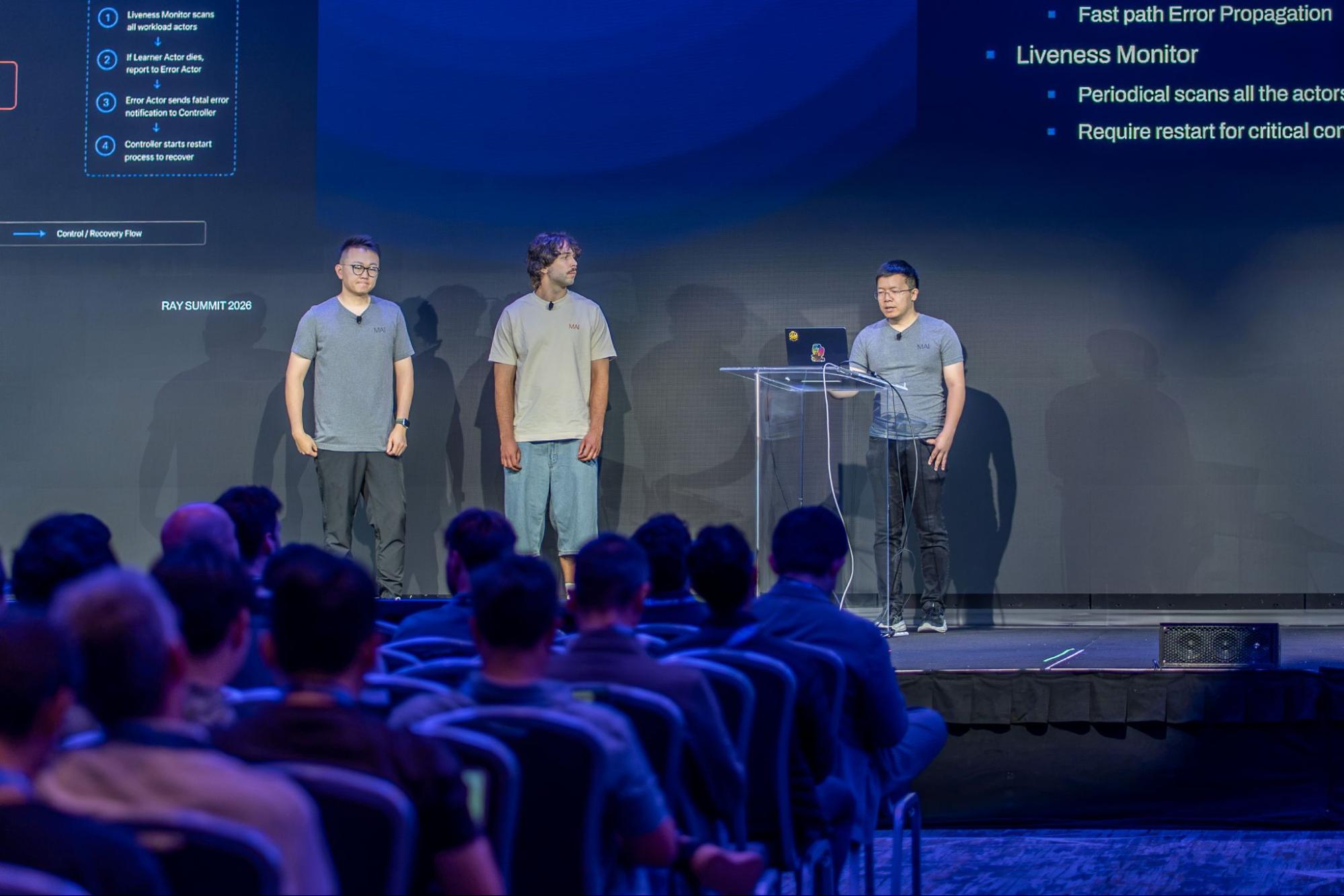 Presented by Cheng Liu, Paweł Bęza, and Shaowei Su, Members of Technical Staff, Microsoft AI
The Microsoft AI team runs data generation, pretraining, and RL across a shared Ray foundation spanning both Kubernetes and Slurm schedulers on a unified GPU fleet. Their central contribution was RELAY, a batch proxy for Ray GCS designed to address a bottleneck in the Ray Client proxy that becomes severe at the world sizes MAI operates at. With the legacy stack, actor creation time degraded from 42.6 seconds at 8,000 workers to 89.4 seconds at 32,000, and steady-state RPC at P99 grew from 18.3 to 55.3 seconds over the same range. RELAY flattens both curves: creation time holds between 32.7 and 34.5 seconds across the full range (2.85 times faster at 32,000 workers) and steady-state RPC holds at approximately 3.6 seconds (16.4 times faster at 32,000), with a hierarchical relay tree further reducing driver-side cost from O(K times S) to O(S).
LinkBuilding a virtual biology platform on Ray: Recursion's multimodal drug discovery engine
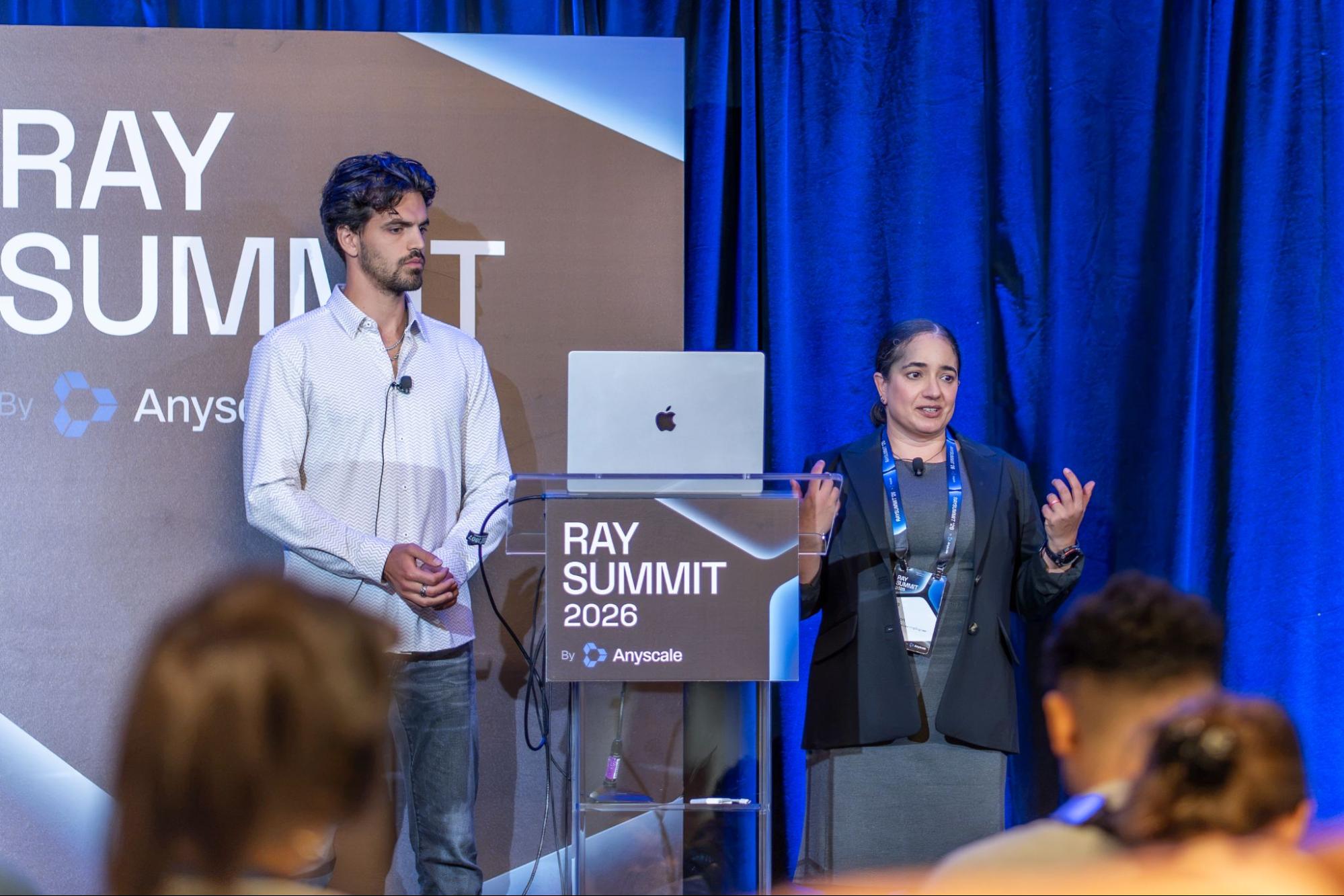 Presented by Aleksandar Djuric and Ayla Khan, Machine Learning Engineers, Recursion
Recursion laid out how Ray sits underneath their entire scientific loop. Cross-modal embedding pipelines combine gene expression, phenomics, and transcriptomics data; predictive chemistry jobs train small-molecule property models and run compound evaluation backfills; and a production online service for Boltz-2, built on FastAPI and Ray Serve running on Anyscale, predicts protein structure and ligand binding affinity from a protein sequence and a ligand chemical structure. Their Virtual Cells work, which trains models to predict phenomic and transcriptional profiles for unseen cellular perturbations, uses Ray for distributed training sweeps, parallel evaluations across checkpoints and cell types, and parallel data loading across accelerators. The key architectural principle they landed on is treating workloads rather than clusters as the unit of work, with routing decisions made on cost, availability, and data locality.
LinkRay in Production: engineering lessons from Spotify's Hendrix platform
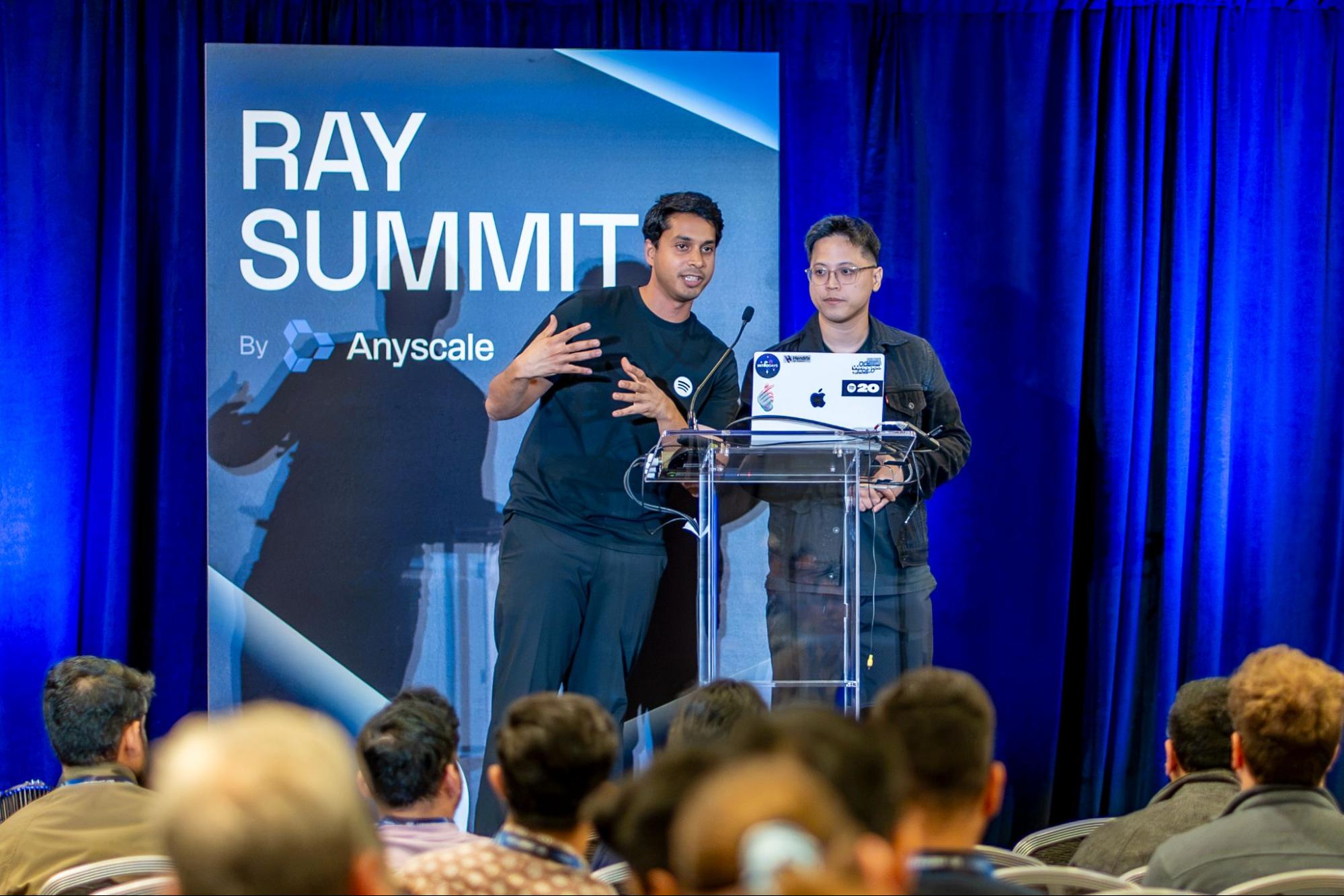 Presented by Aamir Anwar, Platform Engineer, and Shawn Lin, Staff Machine Learning Engineer, Spotify
Hendrix is Spotify's ML platform for the full model lifecycle, running on a multi-tenant GPU fleet spanning multiple GKE clusters and regions with teams isolated in their own namespaces. Over the past year the platform grew 2.5 times in supported teams and 30 times in GPU compute, reaching more than one million GPU hours per month while running roughly 21,000 batch LLM jobs monthly. Aamir and Shawn walked through the composable training workflow on Ray: Ray Data handles a stateless, pickle-safe dataset stage; Ray Train wraps custom loops inside TorchTrainer while the loop owns the forward pass; and evaluation pipelines chain Ray Data processors on CPU workers firing async requests into vLLM and SGLang sidecar worker groups. They also presented two cluster design patterns: single-cluster multiple-runtimes, where each worker pool ships its own container image alongside a lightweight Ray sidecar, and workflow-aware elasticity for scaling resources within a single training run.
LinkScaling massive transformer training with unified KubeRay infrastructure at Capital One
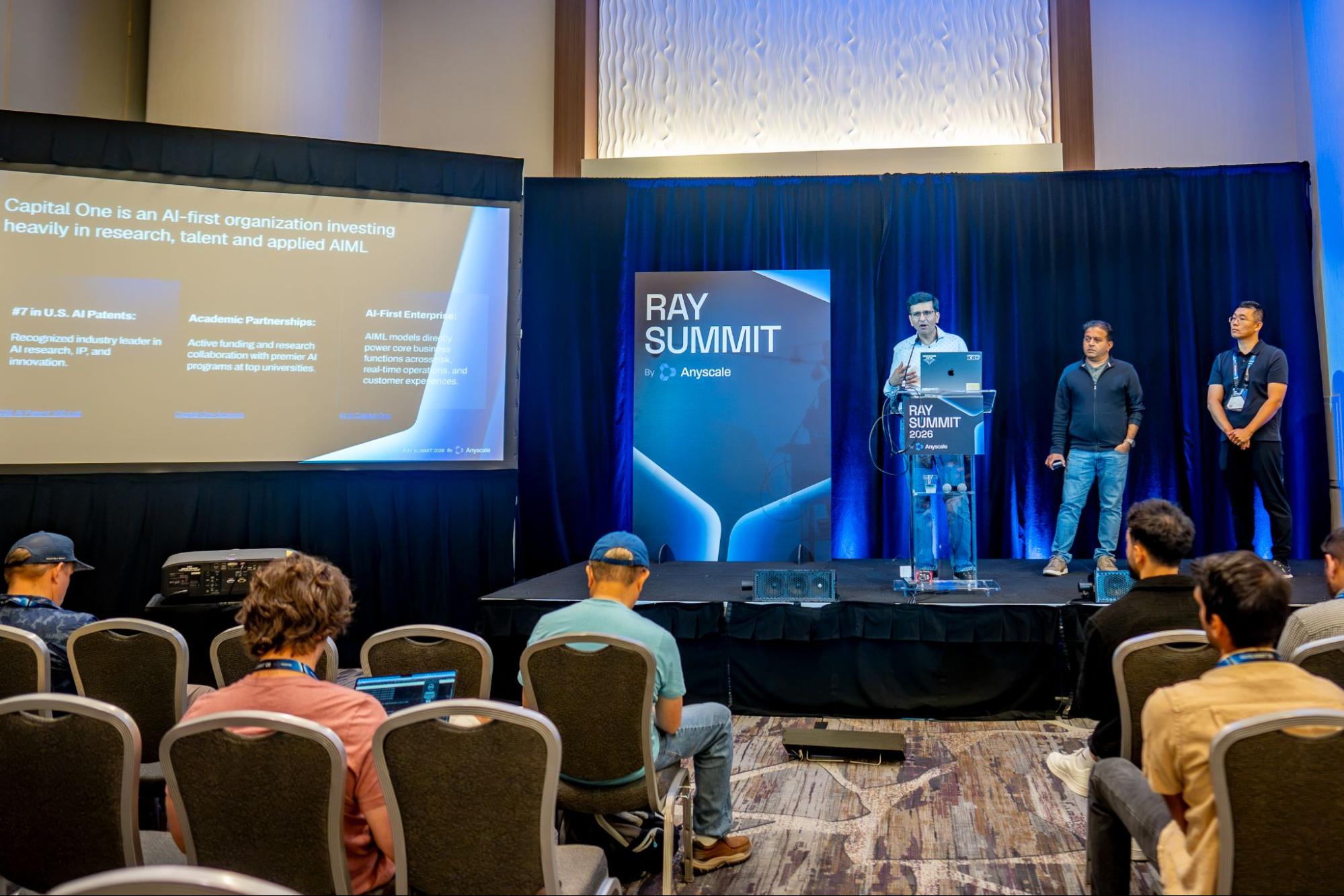 Presented by Maulin Patel, Managing Vice President, and Raja Chawat & Yifei Wang, Machine Learning Engineers, Capital One
Capital One's ML team built a Transformer for tabular financial event sequences and hit a classic scaling problem: with 500 million-plus records and 3.5 terabytes of data across 512 timesteps and hundreds of features each, one training epoch took 32 hours, with data loading rather than compute as the bottleneck. The fix was a unified KubeRay stack across Ray Data (lazy distributed Parquet loading with zero-copy shard passing), Ray Train (TorchTrainer across 64 GPU workers with automatic failure recovery), and Ray Tune with Optuna's TPE sampler and ASHA pruning for 200 concurrent hyperparameter experiments. HPO wall time dropped from three to five days to approximately four hours, a 16 times acceleration, with the full 3.5 terabytes moving through the pipeline end-to-end without a single S3 hand-off between stages.
LinkTraining
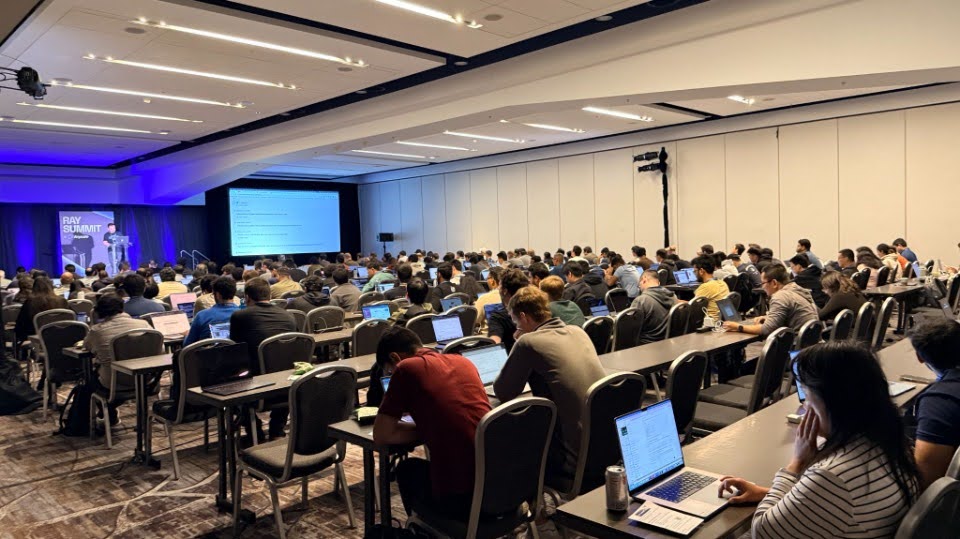
Training at Ray Summit 2026 was the largest it has ever been. Across the two days, we spun up nearly 3,200 GPUs and more than 36,000 CPUs across 830 concurrent clouds and workspaces, then tore it all down and rebuilt it over lunch. Attendance grew from approximately 515 participants last year to well over 800, and at one point a single afternoon session filled the main classroom, the overflow room, and half of a second overflow room, with more than 400 participants working through the material at the same time.
LinkNext Stops
The Ray and Anyscale team will be at several upcoming events if you want to continue the conversations from this week. Come find us at:
Fully Connected, San Francisco (September 29 - Oct 1)
Long Horizon, San Francisco (Oct 20 - Oct 21)
Pytorch Conference, San Jose (Oct 20 - Oct 21)
AI in Drug Discovery & Development Summit (Oct 27 - 29)
Table of contents
- Day 1 keynote
- Building a scaled verifier for science at Lila Sciences
- Building AV 3.0 at Torc Robotics
- Inferact and the vLLM community
- Day 2 keynote
- Building and post-training open models with Ray: lessons from NVIDIA Nemotron
- Advanced autonomy for the built world at Bedrock Robotics
- Closing the loop: building an AI Scientist at Periodic Labs
- Breakout sessions
- Scaling LLM workloads on TPUs with Ray: from pretraining to inference with Google Kubernetes Engine
- Lightning on agentic with vLLM, Verda, Novita and Anyscale
- Scaling Ray at Microsoft AI
- Building a virtual biology platform on Ray: Recursion's multimodal drug discovery engine
- Ray in Production: engineering lessons from Spotify's Hendrix platform
- Scaling massive transformer training with unified KubeRay infrastructure at Capital One
- Training
- Next Stops