Anyscale on Azure Enters Public Preview: Build and Deploy AI at Scale Inside Your Own Azure Tenant
As enterprise AI is moving to production scale, ML and platform engineers face a question they could defer during experimentation: how do you run AI workloads at scale with the same governance and operational controls as the rest of your cloud?
Every enterprise has a valuable data estate, often regulated, mostly unstructured (documents, images, video), and too large to be processed cost-efficiently through token-based, model APIs. That data is a primary source of competitive differentiation that could be turned into proprietary foundation models or domain-specific insights competitors cannot easily replicate. The GPU-accelerated workloads required to do that, including multimodal data processing, distributed training and fine-tuning, and large-scale inference, cannot be handled by the cloud-native services built for structured data and CPU-based processing that enterprises run inside their Azure tenancy today.
Today, we are announcing the public preview of Anyscale on Azure. Any Azure customer can now provision Anyscale, the AI compute platform powered by Ray, inside their own tenancy. Co-engineered with Microsoft and delivered as an Azure Native integration, it inherits the same governance and operational model of first-party Azure services and draws down from existing Microsoft Azure Consumption Commitments (MACC).
Public preview brings the full Anyscale Platform (including the Anyscale Runtime, Workspaces and Agent Skills) so Azure customers can:
Run AI at scale with enterprise-ready Ray. Ray is the open-source AI compute engine governed by the PyTorch Foundation and is used by AI-forward companies including Cursor, xAI, Tripadvisor and hundreds more to run AI at scale. Anyscale, the company behind Ray, turns that framework into an enterprise-grade service with purpose-built developer tooling and managed cluster operations on top of Azure Kubernetes Service (AKS) so AI and platform teams can focus on building differentiated AI systems rather than managing infrastructure.
Focus on delivering competitive differentiation. Teams building production AI systems on proprietary data with Anyscale on Azure include Wayve and Xoople. Wayve is training and deploying autonomous driving AI at the scale needed for safe, real-world deployment. Xoople is focusing on the models that turn planetary-scale satellite imagery into decision-ready intelligence for supply chain, agriculture, and construction industries.
Operate and govern AI workloads with Azure services. As part of the Azure Native integration, teams can set up deployments with Azure Resource Manager (ARM), govern access with Microsoft Entra SSO and Azure RBAC, and manage compliance with Azure Policy.
Pay for Anyscale using existing consumption commitments. Anyscale consumption flows through your existing Azure billing, monitoring, and cost-management services such as Azure Monitor and Microsoft Cost Management.
The rest of this post focuses on what’s new for public preview, where Anyscale fits as enterprises build their own AI systems on Azure, and what customers are doing with it today.
LinkOperating Anyscale as an Azure Native integration
Public preview brings a deeper level of Azure integration to Anyscale. Anyscale resources, access controls, and billing now operate through the same Azure surfaces your platform team already uses for Azure first-party services.
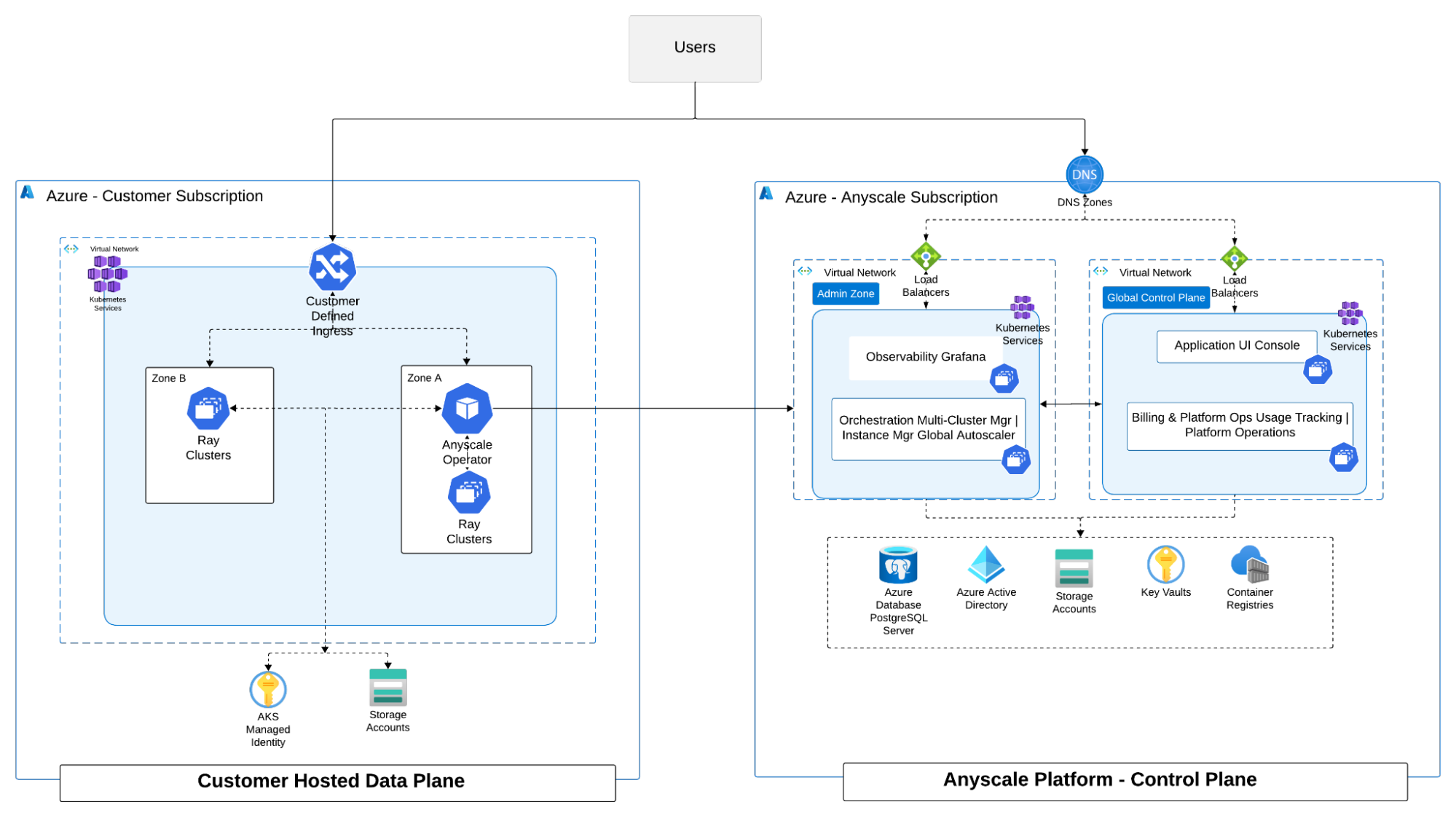 Anyscale resources are native to Azure, governed by Azure RBAC and Azure Policy, and billed through Azure with MACC drawdown.
 Azure Portal. Anyscale clouds are deployed in a few-clicks guided flow through the Azure Portal, which provisions the required storage, managed identity, container registry, and service account, and installs the Anyscale Kubernetes operator. Anyscale resources can also be defined and deployed through ARM templates or Terraform alongside the rest of your infrastructure.
Azure Resource Graph. Anyscale resources show up in Resource Graph queries alongside the rest of your Azure footprint, so platform teams can audit what's running where.
Microsoft Entra ID. Authentication runs through Entra SSO using a standard OAuth flow, with users identified by tenant and object ID so every Entra user type is supported. Conditional access policies that require managed devices for Azure Portal sign-in apply to Anyscale Portal sign-in too.
Azure RBAC. Authorization flows through Azure RBAC against your existing role assignments. We ship three built-in roles that mirror Anyscale's existing roles as a starting point, and will expand the set as we onboard more customers.
Azure Policy. Policy rules apply to Anyscale resources without modification. A rule that blocks resource creation outside approved regions, for example, blocks Anyscale resources outside approved regions.
Microsoft Cost Management. Anyscale usage shows up in Microsoft Cost Management, and is compatible with the third-party tools you already use to monitor Azure usage. Finance teams see Anyscale spend on the same Azure invoice as the rest of your cloud spend.
Microsoft Azure Consumption Commitment (MACC). Anyscale consumption draws down against your existing MACC, which means the dollars you've already committed to Microsoft can fund Anyscale workloads directly. Procurement does not need a separate contract motion to get started.
Together, these integrations mean Anyscale on Azure operates inside the security, governance, and billing architecture Azure customers already trust for native services. Platform teams extend their existing operational model to AI workloads rather than standing up a new one alongside it.
LinkWhere Anyscale fits as enterprises build their own AI systems
The way enterprises consume AI is changing. The first wave of AI adoption was about calling externally hosted APIs to run inference. The next wave is about building AI systems on proprietary data, inside infrastructure the enterprise controls. This is the heart of what's increasingly called sovereign AI: training models on your own data and hosting inference applications, with your own economics, on infrastructure you govern. The companies pulling ahead in industries from fintech to physical AI to ecommerce are training their own models on their own data, with their own economics, and on infrastructure that they govern.
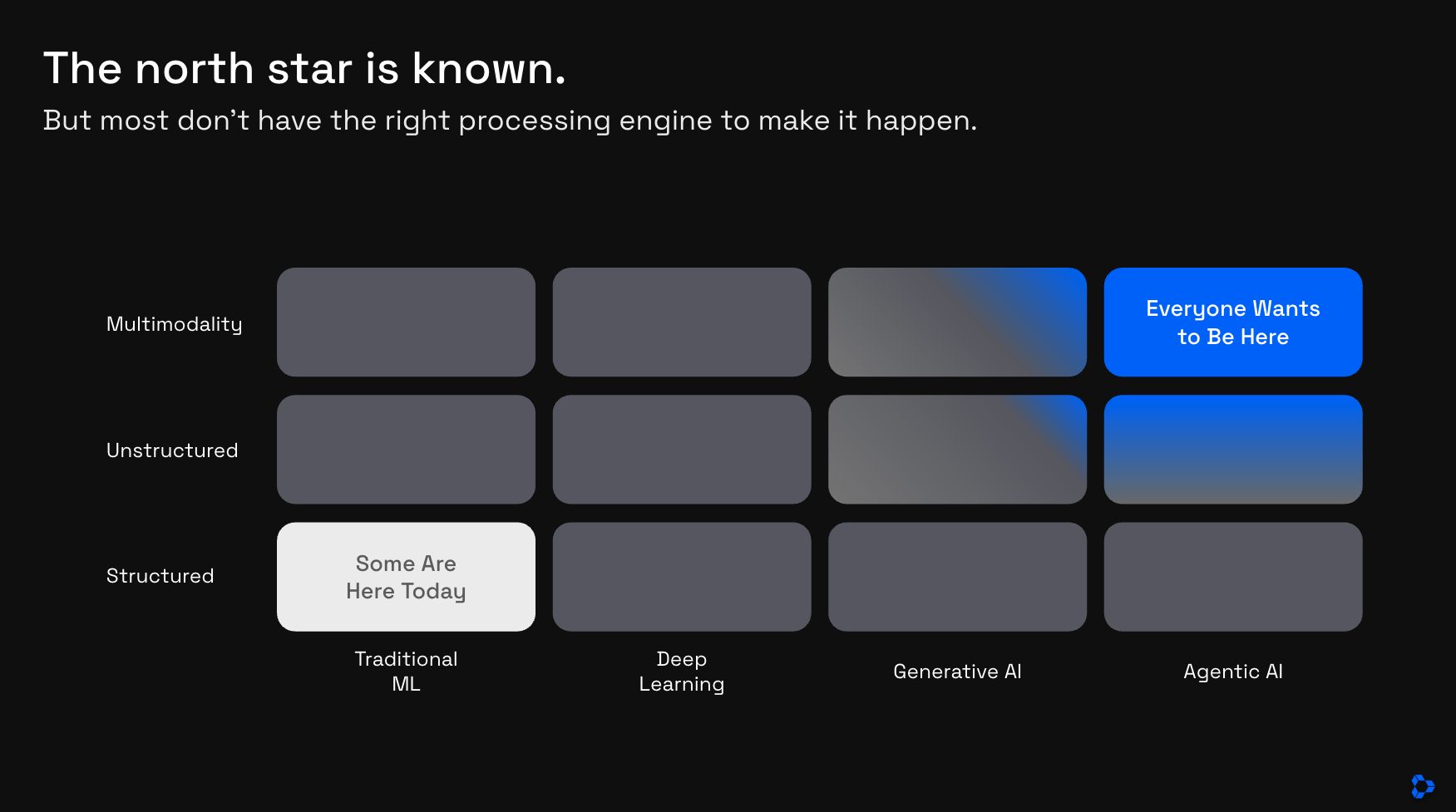 Enterprises AI data and AI processing spectrum.
 The chart above maps the processing buckets required to deliver on this shift along two visible axes: the data you work with and the AI paradigm you apply. But the grid hides a third dimension that matters as much: what are you doing inside a given cell. Every box on this chart could have a minimum of three other workloads – preparing data, training the model and running inference against it. Enterprise AI is the simultaneous combination of these three axes.
Take a retail company trying to optimize its supply chain with a copilot:
Model training. Trained on millions of transactions, a model with a traditional ML or deep learning architecture is trained as often as needed.
Multimodal data pipelines. To keep that model as accurate as possible, the company analyzes and processes multimodal datasets including satellite imagery and weather patterns and feeds them back to the model training run. The processing itself could be using other AI models such as visual language models (VLMs) used to process the imagery.
Composite AI inference. On top of all that sits a planning copilot: a mix of small and large LLMs, and calling of APIs like reading news about certain regions, orchestrated as an agent, that turns a natural-language question ("what happens to Q3 if the Suez backs up again?") that combines external knowledge, newly prepared data and the predictive model to provide recommendations or options with tradeoffs.
TL;DR. One application, three different data shapes, four AI paradigms. All three workloads (data prep, training, inference) run continuously, at different scales, on different hardware (CPU or GPU), and composed into a single system.
This is the space Anyscale is built for. These and other workloads such as embedding generation and LLM reinforcement learning workloads that show up again and again in sovereign AI systems.
LinkWhat customers are doing with Anyscale on Azure
Customers in the public preview cohort are running some of the most compute-intensive AI workloads in their industries on Anyscale on Azure, from planetary-scale geospatial intelligence to embodied AI for autonomous driving.
Xoople is using Anyscale on Azure to run massively distributed AI workloads over planetary-scale satellite imagery, turning complex spectral data into decision-ready intelligence.
“Anyscale lets our teams focus on models and outcomes rather than infrastructure, dramatically accelerating experimentation to deployment. For our product teams and theirs, this means a faster stream of information, more agility, and improved risk management.”
– Milos Colic, VP of Engineering, Xoople
In autonomous driving, Wayve is training and deploying end-to-end deep learning models on Anyscale on Azure, recently demonstrating autonomous driving in Tokyo just four months after onboarding a new Nissan vehicle.
“Wayve and Microsoft have a deep partnership focused on scaling embodied AI and the infrastructure behind it. As Wayve’s AI platform and data operations have grown, Azure has become a core part of its large-scale compute and ML stack.
Wayve uses Ray, and increasingly Anyscale on Azure, to run distributed ML and data pipelines across large CPU and GPU fleets, supporting large-scale inference, analytics, and dataset processing with improved efficiency and resiliency. This enables Wayve to train and deploy its autonomous driving AI at the speed and scale needed for safe, real-world deployment globally.”
– Girish Venkataramani, VP of Engineering, Wayve
LinkGetting started with Anyscale on Azure
You can get started with Anyscale on Azure by following through the steps in this Quickstart Guide.
LinkResources
Get connected
Meet us at Microsoft Build. We're at Build all week. Find us at the event.
Join our upcoming webinar for a deep dive on best practices for Anyscale on Azure. Register now.
Talk to us. Get in touch with questions as you get started.
Read more